History
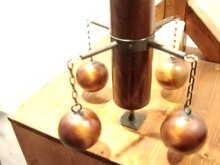
The principle of the flywheel is found in the Neolithic spindle and the potter's wheel, as well as circular sharpening stones in antiquity.
The mechanical flywheel, used to smooth out the delivery of power from a driving device to a driven machine and, essentially, to allow lifting water from far greater depths (up to 200 metres (660 ft)), was first employed by Ibn Bassal (fl. 1038–1075), of Al-Andalus.
The use of the flywheel as a general mechanical device to equalize the speed of rotation is, according to the American medievalist Lynn White, recorded in the De diversibus artibus (On various arts) of the German artisan Theophilus Presbyter (ca. 1070–1125) who records applying the device in several of his machines.
In the Industrial Revolution, James Watt contributed to the development of the flywheel in the steam engine, and his contemporary James Pickard used a flywheel combined with a crank to transform reciprocating motion into rotary motion.


Comments
Post a Comment