Design
Rimmededit
A rimmed flywheel has a rim, a hub, and spokes. Calculation of the flywheel's moment of inertia can be more easily analysed by applying various simplifications. For example:
- Assume the spokes, shaft and hub have zero moments of inertia, and the flywheel's moment of inertia is from the rim alone.
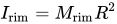
- The lumped moments of inertia of spokes, hub and shaft may be estimated as a percentage of the flywheel's moment of inertia, with the majority from the rim, so that

For example, if the moments of inertia of hub, spokes and shaft are deemed negligible, and the rim's thickness is very small compared to its mean radius (), the radius of rotation of the rim is equal to its mean radius and thus:

Shaftlessedit
A shaftless flywheel eliminates the annulus holes, shaft or hub. It has higher energy density than conventional design but requires a specialized magnetic bearing and control system.
The specific energy of a flywheel is determined by

In which is the shape factor, the material's tensile strength and the density. A typical flywheel has a shape factor of 0.3. Better designs, such as the shaftless flywheel, have a shape factor close to 0.6, the theoretical limit is about 1.


Superflywheeledit
The first superflywheel was patented in 1964 by the Soviet-Russian scientist Nurbei Guilia.
A superflywheel consist of a solid core (hub) and multiple thin layers of high-strength flexible materials, such as special steels, carbon fiber composites, glass fiber, or graphene, wound around it. Compared to conventional flywheels, superflywheels can store more energy and are safer to operate
In case of failure, superflywheel does not explode or burst into large shards, like a regular flywheel, but instead splits into layers. The separated layers then slow a superflywheel down by sliding against the inner walls of the enclosure, thus preventing any further destruction.
Although the exact value of energy density of a superflywheel would depend on the material used, it could theoretically be as high as 1200 Wh (4.4 MJ) per kg of mass for graphene superflywheels.


Comments
Post a Comment