Physics

A flywheel is a spinning wheel, or disc, or rotor, rotating around its symmetry axis. Energy is stored as kinetic energy, more specifically rotational energy, of the rotor:

where:
- is the stored kinetic energy,
- ω is the angular velocity, and
- is the moment of inertia of the flywheel about its axis of symmetry. The moment of inertia is a measure of resistance to torque applied on a spinning object (i.e. the higher the moment of inertia, the slower it will accelerate when a given torque is applied).
- The moment of inertia for a solid cylinder is ,
- for a thin-walled empty cylinder is ,
- and for a thick-walled empty cylinder is ,



where denotes mass, and denotes a radius.


When calculating with SI units, the units would be for mass, kilograms; for radius, metres; and for angular velocity, radians per second and the resulting energy would be in joules.
Increasing amounts of rotation energy can be stored in the flywheel until the rotor shatters. This happens when the hoop stress within the rotor exceeds the ultimate tensile strength of the rotor material.

where:
- is the tensile stress on the rim of the cylinder
- is the density of the cylinder
- is the radius of the cylinder, and
- is the angular velocity of the cylinder.


A flywheel powered by electric machine is common. The output power of the electric machine is approximately equal to the output power of the flywheel.
The output power of a synchronous machine is:
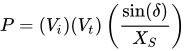
where:
- is the voltage of rotor winding, which is produced by field interacting with the stator winding
- is stator voltage
- is the torque angle (angle between two voltages)


Comments
Post a Comment